The First Circuit recently overturned a thirty-one year old decision on citizen enforcement of the Clean Water Act (CWA). The now-overruled decision is North and South Rivers Watershed Ass’n v. Town of Scituate, 949 F.2d 552 (1st Cir. 1991), in which the court held that citizen enforcement of the CWA was barred when a party has already settled the alleged violations with the state. Notably, Scituate did not distinguish between the type of relief sought – whether the action demanded legal relief or equitable relief.
Blackstone Headwaters Coal, Inc. v. Gallo Builders, Inc. gave citizens the green light to pursue actions seeking equitable relief, even when the defendant had already settled the alleged violations with the state. In Blackstone, a non-profit environmental organization brought suit against four defendant-developers after they had already faced penalties from the state for violations of the CWA. Years prior, MassDEP issued a Unilateral Enforcement Order against the defendants for several violations of the CWA. These violations related to the construction of a large residential development in Worcester known as the Arboretum Village. In response to the order, the defendants entered into an Administrative Consent Order with Penalty with MassDEP and paid an $8,000 administrative penalty and undertook remedial actions at the site. Years later, the citizens group filed suit against the defendants for those same violations seeking (i) a declaratory judgment that the defendants were in violation of the CWA, and (ii) an injunction prohibiting further violations of the CWA. Relying on Scituate, the defendants claimed the suit was statutorily precluded by 33 U.S.C. s. 1319(g)(6)(A), which bars “civil penalty action[s]” initiated via a citizen suit.
Notwithstanding the holding in Scituate—which if honored would have provided a victory for the defendants—the First Circuit clarified when citizen enforcement actions of the CWA are permissible. Looking to the legislative history, the court noted that the limitation on “civil penalty actions” does not apply to an action seeking other forms of relief, such as an injunction or declaratory judgment. The First Circuit also looked to a decision by the Tenth Circuit in Paper, Allied-Industrial v. Continental, 428 F.3d 1285 (10th Cir. 2005), which reasoned that the governing principle behind the bar on “civil penalty actions” is to “avoid duplicative monetary penalties for the same violation.” Equitable remedies do not run astray of this principle and, accordingly, are not barred by the statute.
 Since our post on
  The outbreak of COVID-19 (“coronavirus”) has impacted all industries, including construction. First and foremost, we are in the midst of a public health crisis, and the safety and well-being of all project participants should be top of mind. We are also looking at significant economic risk and uncertainty. Our state and federal governments have issued emergency orders. The City of Boston this week announced a complete shutdown of construction projects, with other jurisdictions likely to follow suit.
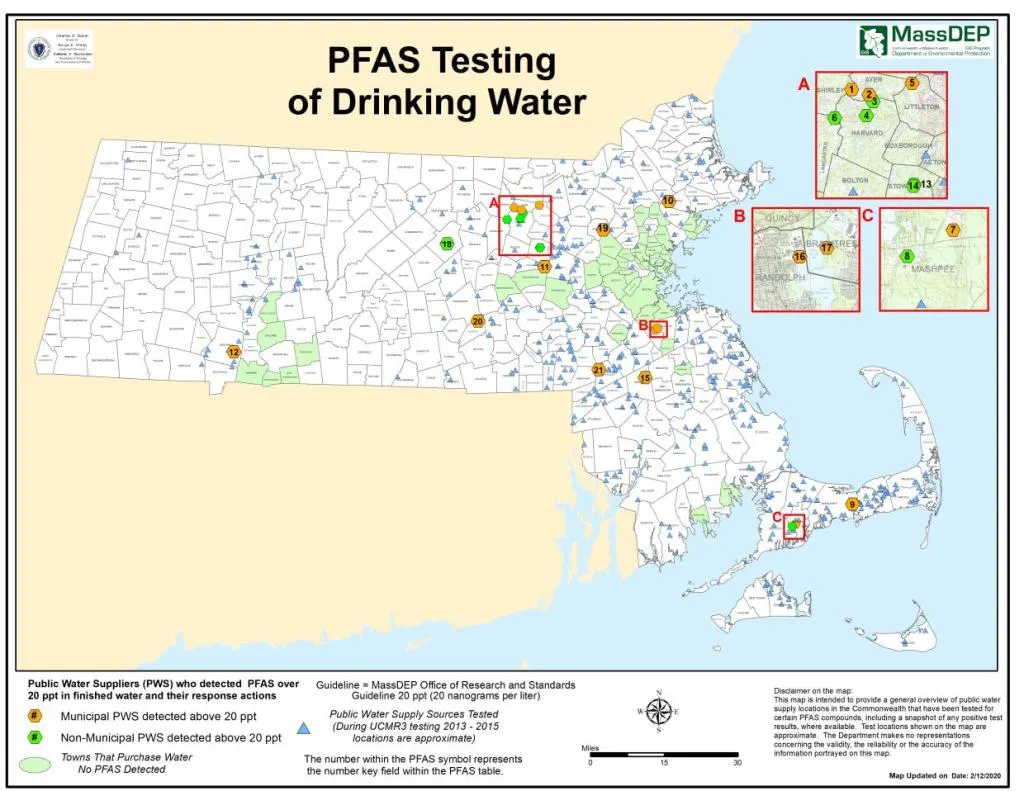 Many of our readers will be aware that on December 27, 2019, the Massachusetts Department of Environmental Protection (MassDEP) proposed a Maximum Contaminant Level (MCL) for PFAS in drinking water of 20 parts per trillion (0.02 ug/L or ppt) for six PFAS chemicals combined. To that point, PFAS generally was not regulated in Massachusetts drinking water. MassDEP’s MCL proposal follows its adoption last year of a reportable concentration for PFAS, also at 20 ppt, for soil and groundwater contamination under Massachusetts General Laws, Chapter 21E and the Massachusetts Contingency Plan (310 CMR 40.0000). Massachusetts has been more proactive from a regulatory standpoint than many states in attempting to deal with the PFAS problem.
  In 2019, Mirick O’Connell’s permitting attorneys were proud to help our clients, large and small, with local approvals in Marlborough for 6 great projects.


 On Solid Ground: The Mirick Real Estate Law Blog